
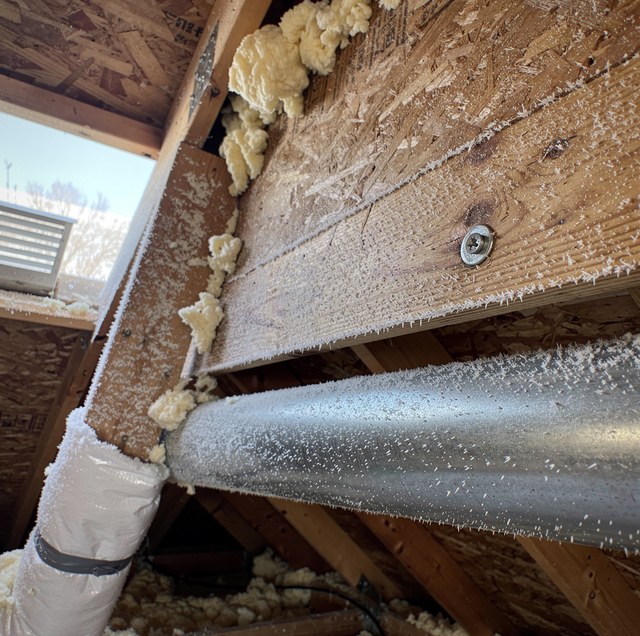
Frost crusting the underside of your roof sheathing on a cold morning, or a damp ring around the attic hatch on a humid afternoon, traces back to water vapor that was already inside your house, rising into the attic and turning back into liquid or ice the moment it touches a surface cold enough to force it out of the air. That temperature is the dew point: the point at which air holding a given amount of moisture can no longer hold it as vapor, so it condenses on the coldest thing it touches. In an attic, that surface is usually the underside of the roof deck, an exposed nail, or a duct running colder than the air moving past it.
A one-time leak reads differently on the sheathing: a stain radiating from a single point, usually tracing a rafter or a valley, rather than a broad, even dampness. That distinction is worth ruling out early, and once it is, the question that remains is about the vapor itself: where it starts and what actually stops it.
A glass of ice water left on a table on a warm, humid day sweats for the same reason. The glass isn't leaking; the surrounding air is warmer and wetter than the glass surface, and the moment that air touches the cold glass, the water it already carries condenses and beads up. The water was in the room the whole time. An attic roof deck does the same thing at a larger scale: the wood was never wet to begin with, and it ends up dripping anyway.
The mechanism doesn't care what month it is. In a cold-winter climate, the coldest surface in the house is usually the roof deck, and frost is the visible result. In a hot, humid stretch, the coldest surface is often a duct or a section of ceiling running under a hard-working air conditioner, and the same vapor condenses there instead: the moisture problem doesn't disappear once the frost season ends; it just relocates and changes form. Fixing it means finding where the vapor is coming from and where it's meeting that cold surface, in any season.
Bath and Kitchen Fans Venting into the Attic
A shower, a load of laundry, or a pot of pasta on the stove all push a surprising amount of water vapor into the air, and the exhaust fan is supposed to carry it straight outside. The problem shows up when the ducting doesn't actually reach the outside: it's common for bath fan ducting to run a few feet into the attic and just stop, either uninsulated or crushed flat somewhere along the run, dumping every bit of that moisture directly into the attic instead of past the roofline. A kitchen exhaust routed the same way handles cooking steam. Every use of that fan is effectively a small humidifier running in the attic, whether the season is warm or cold.
Unsealed Ceiling Penetrations and the Stack Effect
Warm air rises, and as it rises through the house it carries moisture with it, escaping through any gap in the ceiling plane the way water finds a crack in a dam. Recessed can lights that aren't rated airtight are a common gap. So is the plumbing stack penetration, where the pipe running up from below passes through the attic floor. Top plates, where interior partition walls meet the attic, are often never sealed during framing at all. An attic hatch without weatherstripping is effectively a hole in the ceiling the size of a doorway. Individually, none of these look like much; together, they're the main path warm, moist air uses to reach the cold surfaces above it.
An Unvented or Poorly Vented Crawl Space Feeding the Whole House
A crawl space without proper vapor control constantly releases moisture from the soil and framing below, and that moisture rises through the subfloor and interior walls along the same stack-effect path that already carries vapor from the rooms above. Whatever starts in an unmanaged crawl space ends up as one more source feeding the same attic surfaces already struggling with bath fans and ceiling gaps, not a separate problem with a separate fix.
Unconditioned Air Handlers and Duct Leakage in the Attic
An air handler or a run of ductwork in an unconditioned attic is, by itself, a cold or hot surface depending on the season, and it sits directly in the path of any moist air moving through that space. In summer, a metal duct carrying chilled air can run so cold it sweats, just like a drink glass, dripping onto the insulation below. Leaky duct joints make it worse in both directions, pulling attic air into the system or pushing conditioned air out and disturbing the pressure balance that would otherwise keep vapor from migrating toward the coldest surfaces.
Everyday Household Humidity Load
Cooking, showering, laundry, houseplants, an aquarium, and simple breathing all add water vapor to a home's air over the course of a normal day, and none of it requires anything to be broken. In a well air-sealed house, that vapor stays in the living space and leaves through exhaust fans and normal air exchange. In a house with an open path to the attic, ordinary daily living becomes attic moisture, on top of whatever the fans and penetrations above are already contributing.
| Moisture Source | Telltale Sign | Primary Fix |
|---|---|---|
| Bath or kitchen fan | Wet or frosted duct end short of the roofline | Reroute duct to terminate outside |
| Ceiling penetrations | Staining or frost directly above a can light, hatch, or stack | Air-seal the ceiling plane |
| Crawl space | Damp, musty air pulling up through interior walls | Correct crawl space vapor control |
| Attic ductwork | Sweating or dripping duct jacket | Insulate the duct run; have an HVAC pro seal the joints |
| General humidity load | Even, low-level frost with no single hot spot | Balance ventilation and indoor humidity |
Air Sealing the Ceiling Plane
Of all the levers here, air sealing the ceiling plane does the most for moisture specifically, because it stops vapor from reaching the attic in the first place rather than managing it once it's already there. The same penetrations named above- the can lights, the stack boot, the top plates, the hatch- are the targets. Closing them removes the moisture load that drives the frost and condensation described throughout this article, not a general efficiency upgrade with a side benefit.
Air-sealing the ceiling means working across exposed joists, where missed steps go through drywall below. Blown insulation hides the framing, dust is respirable, and old, damp sheathing can harbor microbial growth: this is crew work requiring fall protection and a respirator.
Correcting Exhaust Termination and Balancing Ventilation at Soffit and Ridge
Any fan currently dumping into the attic needs to be rerouted so its duct actually terminates outside, through the roof or a gable, not just re-aimed at a different part of the same attic. Cutting the fan and sealing the ceiling plane stops new vapor from arriving, but the attic's own ventilation path is what clears whatever moisture is already there. It keeps the space from holding onto it, which is why a duct reroute done without checking that the vent path is intact still leaves a slow-drying attic behind.
When a bath fan gets rerouted, have the crew check the full duct run, not just the termination point. A sagging low spot in a flexible duct traps condensate and blocks airflow as badly as a duct that never reaches the roof.
Insulation Depth and Coverage
Insulation's role is narrower than it sounds: thin or compressed insulation leaves the ceiling surface closer to whatever temperature is on the other side of it, which narrows the margin before that surface hits dew point, whether that's the roof deck above a gap in the batts or the drywall ceiling itself under a heavy summer cooling load. Getting coverage right matters more than the material: blown cellulose or fiberglass, dense-pack in tight cavities, or kraft-faced batts with the vapor retarder facing the conditioned space rather than the attic side, laid evenly and without gaps or compression.
Frequently Asked Questions
A north-facing slope stays colder longer because it gets little or no direct sun to warm the sheathing back above dew point during the day, so vapor condensing there has less chance to dry out before the next night adds to it. A single bay that frosts while its neighbors stay clear usually points to something local: insulation that's thinner there from a batt that shifted or compressed, a nearby duct or fan connection dumping vapor right at that spot, or framing running colder because it sits over an uninsulated soffit return. Frost concentrated in one place is a pointer to that spot's own cause, not a sign the whole roof is affected equally.
Usually not, and it can make it worse. A powered vent fan pulls air out of the attic, and if the ceiling plane below it is leaky, it pulls conditioned house air up through those same gaps faster than a passive vent would. The fix is to close the air path between the house and the attic, not to move more air once vapor is already there.
Yes. Running a whole-house humidifier's humidistat on a warm-weather setting once outdoor temperatures drop can push more vapor into the air than a modest ceiling air barrier can handle, since most humidistats have a dial that's meant to be turned down as it gets colder outside. Turning that dial back is often part of the fix, not just sealing and insulation.
It changes the system rather than patching a symptom. Closed-cell foam applied to the underside of the roof deck moves the dew point into the foam itself and converts the attic to conditioned space, which usually means the soffit vents get closed off as part of the job. Installations normally include an ignition- or thermal-barrier coating over the foam, which the installer specifies for the assembly and which varies by product and by what's required for that space. A partial application that skips closing the old vents can trap moisture rather than stop it.
Only if the duct actually reaches outside. Running the fan longer moves more air, but a duct that dead-ends in the attic just relocates that air a few feet before it stops. A humidity-sensing fan control reads the room's actual moisture level instead of running on a fixed clock, so it keeps the fan on through a long shower or a big pot of pasta and shuts off on its own once the air actually clears, rather than cutting out at a preset time whether the room is dry yet or not.
Not by itself. Frost is just frozen water vapor and isn't mold on its own, but sheathing that undergoes repeated freeze-thaw cycles while wet over a season is more likely to develop surface mold than sheathing that stays dry. That's a separate question worth having a qualified inspector look at, rather than something frost alone proves one way or the other.
Get a free attic air-sealing and ventilation check — find every gap and vent imbalance feeding the moisture before it turns into rot or mold. Airflow Pro Insulation serves St. Joseph, Savannah, and Country Club. Call (816) 344-6516.
