
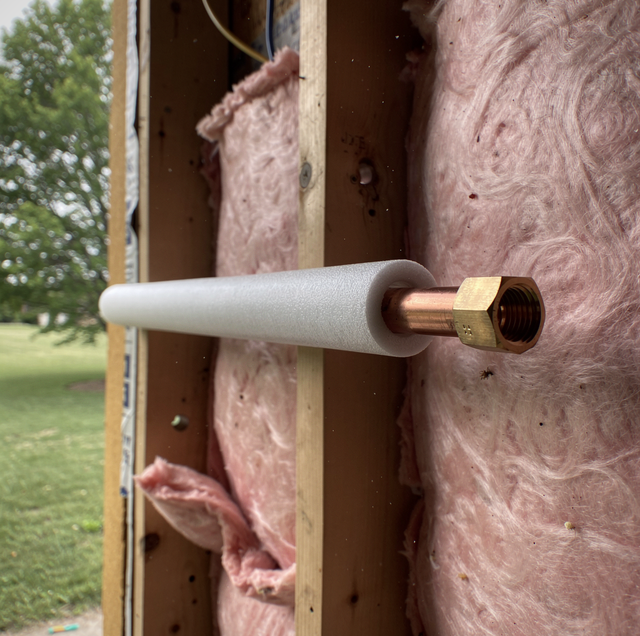
The kitchen tap on the outside wall runs fine all autumn, then, on the first hard, cold night, it gives nothing while every other fixture in your house still works. That line sits in an exterior wall cavity a few inches from the weather, with whatever insulation the framing carpenter managed to get behind it, which is often none at all.
Freezing is not really a plumbing event at that point. It is a temperature that reached a pipe because the building let it through, making it an envelope question before anything else. Insulation changes how fast heat leaves your pipes and how cold the air around them gets, so what it can and cannot do for you is worth knowing precisely.
Where the Cold Actually Reaches a Pipe
Pipes freeze where the building stops holding heat around them, and in most houses that is a short list. The first is the exterior wall cavity. A line run inside an outside wall shares those few inches of framing with the insulation, and if it sits outboard of the batt, it spends cold nights near outdoor temperature.
The second is an unconditioned attic. Above the insulated ceiling plane, the temperature is essentially the outdoor temperature, so a line running to an upstairs bath or a far-side fixture passes through outdoor air, with only its own covering around it.
The third is the rim joist, the band of framing that sits on the foundation wall and carries the floor above. It is a seam between masonry and wood, usually the leakiest line in a basement, and water lines commonly turn there on their way up. Your basement can feel comfortable while the air moving through that band is not.
What Wrap Does, and What the Cavity Behind It Does
Wrap slows the rate at which heat leaves the water; it adds no heat of its own. A wrapped line in cold air still cools, only more slowly, and that is often enough to carry a pipe through a night that would otherwise have frozen it. What it cannot do is hold a pipe above freezing in air that stays below it.
In an exterior wall, the wrap is only part of the answer. What matters at least as much is the order of the layers: whether insulation sits between the pipe and the outdoors, and whether outdoor air can move through the cavity and wash across the pipe. If pipes must be placed in exterior walls, they need to be insulated with suitable cavity insulation installed behind them, and the wall cavity needs to be air-sealed to keep cold air from flowing around the pipes. Behind means on the outside, so the pipe finishes on the warm face of the insulation rather than being buried in it.
Sealing is the half most often skipped, because it disappears once the wall is closed. To further protect pipes, the wall cavity holding them should be air-sealed with caulking or by foaming all seams between the back wall of the cavity and the framing, and by sealing any holes through the framing for the piping, with cavity insulation installed behind the pipes, between them and the exterior wall. Insulation slows conduction; it does nothing about moving air.
Why Fit and Coverage Change What Wrap Delivers
Pipe insulation is not a single product, and the form you use matters less than getting it tight to the pipe. It comes in several forms: tubular pipe sleeves, spiral insulation wrap, and fiberglass batts that can be taped around the pipes. When properly installed, any of these can be effective. Clean and measure pipes before buying insulation and match the pipe's outside diameter to the sleeve's inside diameter to get a snug fit. A sleeve too large leaves an air gap.
Coverage is the other half. It matters to insulate all exposed surfaces, including tees, valves, and faucets, since exposed surfaces can cause localized freezing. Covering a fitting takes mitered cuts or taped wrap, which is the step a hurried job skips.
A wrapped run with a bare elbow, tee, or valve has a cold spot, and freezing starts at the uncovered fitting rather than along the covered pipe.
What Grows on a Cold Pipe Inside a Finished Wall?
Turn the season around, and the same pipe has the opposite problem. A cold water line inside a wall or a floor cavity in warm, humid weather is the coldest surface in that space, and humid air touching a surface below its dew point gives up water onto it. The pipe sweats, and the drops land on framing and batt facing you never see.
What grows after that is mold on damp paper and damp wood, and the insulation takes the second hit: wet fiberglass conducts heat far better than dry fiberglass, so a soaked batt loses much of its rated value while it stays wet and traps moisture against the framing. The freeze protection you paid for in one season is worn down by the other. Wrap with a vapor barrier, keeping humid air off the pipe, stops that cycle at the start.
What Insulation Cannot Do on Its Own
There is a limit worth stating, because the alternative is believing a wrapped pipe cannot freeze. If the temperature stays low enough for long enough, pipes will freeze without added heat input, whether from fluid movement (running water) or from a heat tape or trace that carries enough Btu to offset the loss. Insulation buys time; past a point, only heat or movement changes it.
That leaves two honest answers for a line that keeps freezing. One is added heat: heat tape or heat trace, an energized accessory belonging to the trade that installs it, not to a homeowner with a ladder. The other is to keep the pipe indoors at all times, with insulation and air sealing that bring the cavity, the attic run, or the rim joist inside the envelope.
Once the season turns, the same work reads differently. The wrap that carries an attic line through a cold night keeps it from sweating onto the ceiling in humid weather, and the cavity insulation that keeps outdoor air off a wall pipe keeps humid air off the pipe. That is why you want this looked at while the weather is mild rather than on the night a fixture quits.
Frequently Asked Questions
Yes. Heat loss in uninsulated hot water pipes runs 16% to 23%, and adding ¾-inch pipe insulation can cut overall water-heating energy use by 4% to 5% annually. You notice it as a shorter wait for hot water at your taps, and as less heat lost into framing you never heat.
Look at where your fixtures sit. A kitchen sink under a window, a vanity on a gable end, a laundry box backed to siding, and an outdoor spigot are fed by lines in cold framing. Those are the runs that quit on you first, before your others.
No. Foam packed around a pipe leaves it outboard, close to the sheathing, with little between it and the cold. Cavity insulation goes between your pipe and the outdoors, so your line ends up on the interior side of the insulation, which is where you want it.
It can recover if it dries fully and fast and nothing crushed it while it was heavy. What you usually get instead is slow drying in a closed cavity, matted fibers, and a batt no longer touching the framing, leaving you gaps in your walls for cold air.
Often. A wall cavity can be insulated behind the pipe, but an attic line sits in open air above it, so your options are wrap plus depth over the run, or moving it below the plane. Ask for both before you accept wrap.
Because freezing is local. It happens at the coldest few inches of a run, not across the system, so the fixture that quits is the one whose line passes closest to the outdoors with the least material around it. A bare valve in a wall cavity, an elbow poking out of a sleeve, or a line crossing an unheated bay will all freeze while identical pipe ten feet away, inside your conditioned framing, stays open and running for you all winter long.
Have the exposed runs in your walls, attic, and rim joist inspected before the cold arrives — a closer look at where the pipes are located and what the cavity is missing. Airflow Pro Insulation serves St. Joseph, Savannah, and Country Club. Call (816) 344-6516.
