
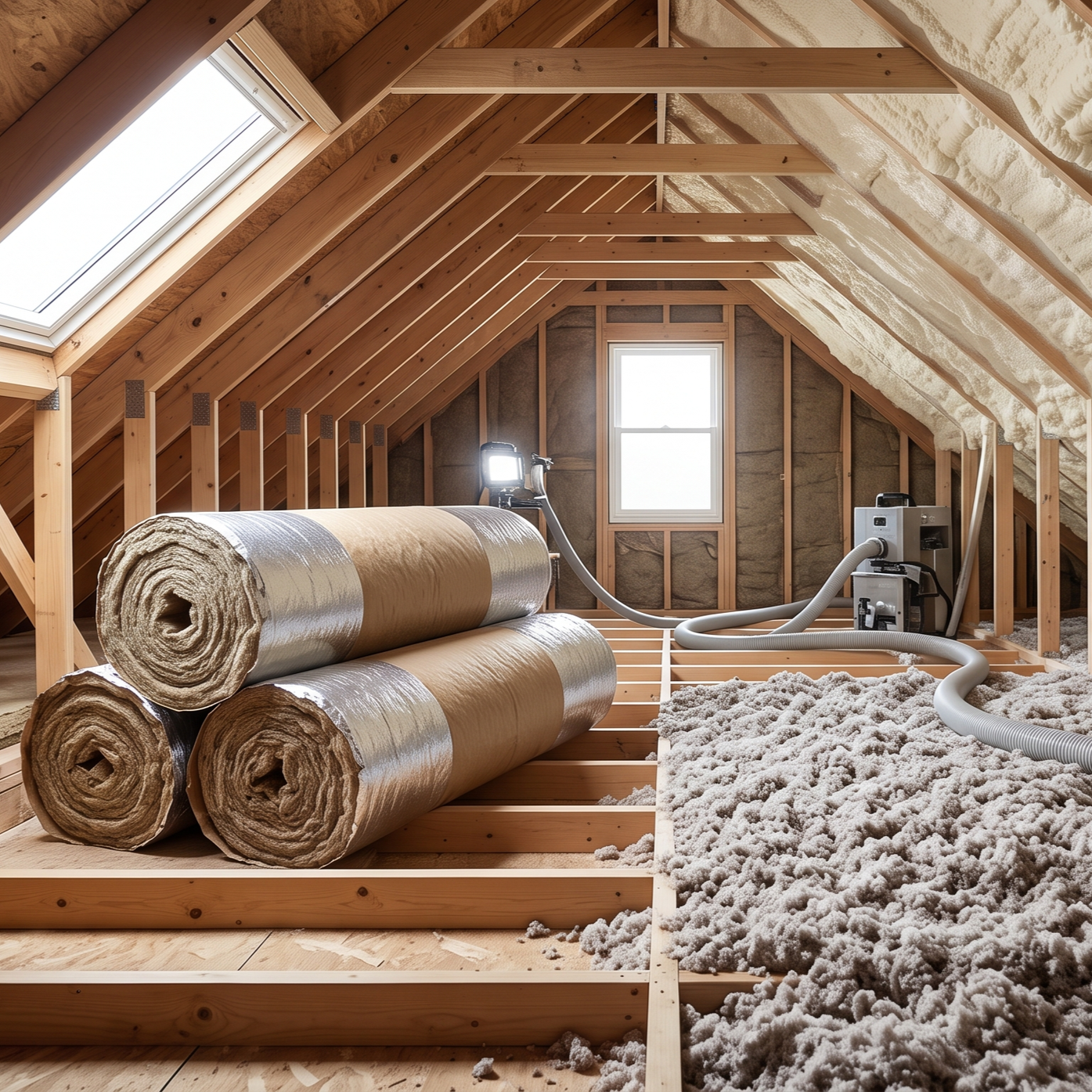
You climb into the attic to figure out why the upstairs bakes in July and freezes in January, and you find a patchy layer of old insulation that clearly is not doing its job. Now you are staring at three choices with confusing names: batt, blown-in, and spray foam, and every website seems to say a different one is best.
They are not really competing for the same job. Each behaves differently once it is in the wall or the attic, and the right pick depends on where it is going and what you need it to do. Once you understand how each one works, the choice gets a lot clearer.
What "Insulation" Is Actually Doing
Two different things keep a house comfortable, and they are easy to confuse. The first is the slowing of heat as it moves through a surface, which is what an R-value measures, with higher values indicating better performance. The second is stopping air from leaking through gaps, which R-value does not measure at all. A material can have a high R-value and still let air pour through cracks around it. Real comfort needs both: resistance to heat flow and a seal against air movement. The three insulation types split along exactly this line, and that is the key to telling them apart.
Batt: The Familiar Blanket
Batt insulation is the pink or yellow fiberglass roll most people picture, precut to fit between studs and joists. Fiberglass batt runs about R-3.1 to R-3.4 per inch, so a standard wall cavity gets you into a respectable range. It is simple to install in open, regularly spaced framing, which makes it a sensible choice for new walls, accessible floors, and standard stud bays.
Its weakness is the seal. Batt only insulates as well as it fits, and any gap, compression around wiring, or space it does not fill becomes a path for air. Cut it short or stuff it around an obstacle, and its real-world performance drops well below the number on the package. Batt resists heat well when installed perfectly, but it does nothing to stop air on its own.
Blown-In: Filling the Spaces Batt Can't
Blown-in insulation is loose material, usually cellulose or loose fiberglass, blown through a hose to settle into a space and fill it completely. Cellulose runs about R-3.2 to R-3.8 per inch, and because it flows into every nook, it covers the gaps, odd cavities, and around-the-obstacle spots where batt leaves openings. That makes it the go-to for existing attics, where it can be blown over the top of what is there to build depth quickly, and for finished walls where there is no way to open the framing.
It seals better than batt because it fills more completely, but it is still not an air barrier like foam is. Over many years, loose fill can settle and lose some depth, and in a wall, it can be harder to inspect. For a big attic that needs more R-value fast, though, it is often the most practical answer.
Spray Foam: Insulation and Air Seal in One
Spray foam is the one that does both jobs at once. Applied as a liquid that expands and hardens, it insulates and seals the surface it covers, and it comes in two very different forms. Open-cell foam runs about R-3.5 to R-3.9 per inch, is softer, and acts as an air barrier. Closed-cell foam is the heavy hitter at roughly R-6 to R-7 per inch, the highest of any option, and it doubles as both an air barrier and a moisture and vapor barrier, adding a little structural rigidity as well.
That air-and-moisture sealing is what sets foam apart. In a humid summer, sealing air leaks stops warm, damp outdoor air from sneaking into cool wall cavities where it can condense. In a cold winter, the same seal stops warm indoor air from carrying moisture into the attic, where it can cause ice dams and rot. Foam costs more and requires a trained crew, but for crawl spaces, rim joists, and problem areas where air and moisture are the real enemies, nothing else matches it.
| Type | R per inch | Air seal | Moisture control | Best for |
|---|---|---|---|---|
| Fiberglass batt | ~3.1–3.4 | No | No | Open new framing, standard stud bays |
| Blown-in cellulose | ~3.2–3.8 | Partial | No | Existing attics, finished walls |
| Open-cell spray foam | ~3.5–3.9 | Yes | Limited | Interior walls, sound damping |
| Closed-cell spray foam | ~6–7 | Yes | Yes | Crawl spaces, rim joists, damp areas |
Why the Climate Points to a Mix
In a place that swings from humid, sticky summers to hard winters, a home rarely needs just one product. The attic that bakes the upstairs in summer usually wants deep, gap-free coverage, which blown-in delivers well and affordably. The crawl space or rim joist where damp air and winter cold cause the most trouble usually wants foam's air-and-moisture seal. And open, accessible new framing may be perfectly served by batt. A good assessment looks at each area, summer and winter both, and matches the material to what that spot actually fights, rather than forcing one product everywhere.
Frequently Asked Questions
Closed-cell spray foam, at roughly R-6 to R-7 per inch, is the highest of the common options. Blown-in cellulose and fiberglass batt sit in the R-3 range per inch, and open-cell foam is close to them. But R-value per inch is only part of the story, since foam also seals air and batt does not, so the best choice depends on the space, not just the number.
Yes, and it is a common way to add R-value without tearing anything out. Blown-in material settles over the existing batt, filling the gaps and building depth quickly. Just make sure the old insulation is dry and not moldy first, because you do not want to bury a moisture problem under a fresh layer.
It depends on the job. In open, easy-to-reach framing, batt or blown-in may give you the R-value you need at a lower cost. In crawl spaces, rim joists, and anywhere air leaks and moisture are the real problem, foam's ability to seal as it insulates does something the others cannot, which is where it earns its place.
Both, and that is the point people miss. Insulation and air sealing slow heat moving in either direction, so they keep summer heat out and winter warmth in. A house that is miserable upstairs in July and drafty in January usually has the same root cause: too little insulation and too many air leaks working against it in both seasons.
Open-cell foam is lighter and softer, insulates around R-3.5 to R-3.9 per inch, and seals air but not moisture. Closed-cell is denser, insulates around R-6 to R-7 per inch, and blocks both air and moisture while adding rigidity. Closed-cell costs more and is the choice when moisture control matters, such as in crawl spaces.
Look at where the discomfort is and what causes it. An under-insulated attic usually wants added depth from blown-in. A damp or drafty crawl space usually needs foam's seal. Open new walls can take batt. Because most homes have more than one problem area, the answer is often a combination, which is why an on-site look beats a one-size recommendation.
Match the Material to the Space
There is no single best insulation, only the best one for a given spot. Batt is the simple blanket for open framing; blown-in is the gap filler that builds attic depth fast; and spray foam is the one that insulates and seals air and moisture, where those are the real problems. A comfortable, efficient home usually uses more than one, chosen area by area for the job it has to do in both summer heat and winter cold.
If your home is hot upstairs in summer and drafty in winter, the fix is usually the right insulation in the right places. Airflow Pro Insulation serves St. Joseph, Savannah, Country Club, and the surrounding area. Call (816) 344-6516 for a free assessment.
