
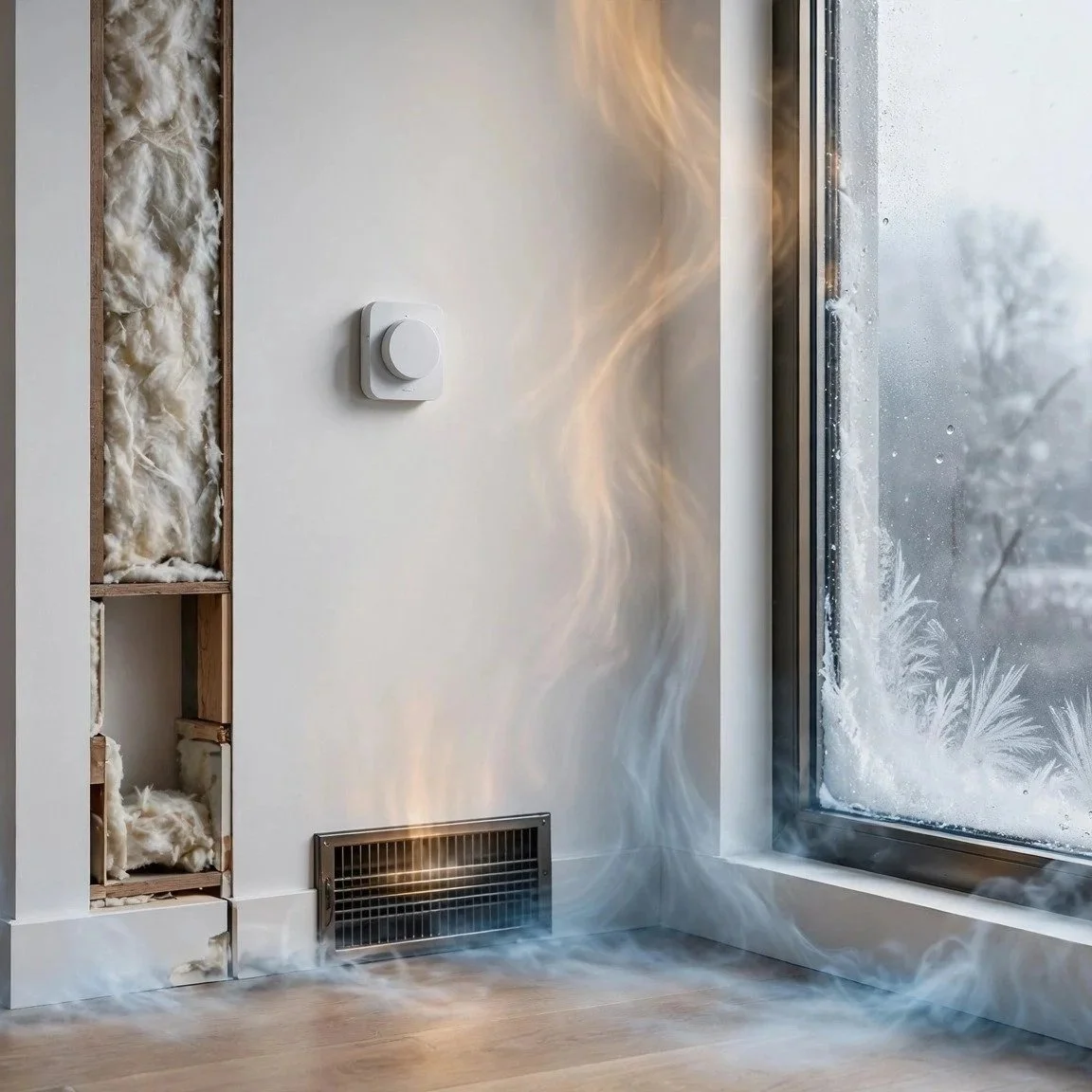
Quick Answer: A draft is rarely just cold air sneaking in. It is air movement, driven by the stack effect (warm air escaping high in the house and pulling replacement air in low) and by convection rolling off cold surfaces. The fix is usually air sealing at the top and bottom of the house, not simply piling on more insulation.
You have the thermostat set where you like it. The furnace is running. And yet you sit down on the couch and feel a slow, cool current sliding across your ankles, or a chill along one wall that never quite goes away. It feels wrong, like the heat is not doing its job. In most homes, it is doing its job. Something else is moving air past you faster than the furnace can keep up, and once you understand what that something is, the drafty feeling stops being a mystery.
A Draft Is Air Movement, Not Just Cold Air
Start with the mechanism, because the fix follows from it. When people say "draft," they usually picture cold outdoor air pushing through a gap. That happens, but it is only half the picture. A house behaves a lot like a chimney. Warm air is lighter than cold air, so the heated air inside your home rises and works its way out through gaps up high, in the attic, and along the top of the walls. As that warm air leaves, it has to be replaced, so the house pulls cold air in through gaps down low, at the rim joist, the sill, around basement penetrations, and along the bottom of exterior walls. Building scientists call this the stack effect, and it occurs continuously whenever there is a temperature difference between the inside and the outside.
Picture the house as a tall glass of soda with a lid that does not quite seal. Bubbles rise and slip out the top, and to replace the volume, air seeps in at the bottom. Your home does the same thing with heated air, all day, all winter. The stronger the temperature difference, the harder it pulls. That is why the draft you feel across the floor gets noticeably worse on the coldest nights.
There is a second, quieter source of the drafty feeling: convection off cold surfaces. If a wall, window, or ceiling is cold because the insulation behind it is thin, missing, or crushed, the air touching that surface cools, becomes denser, and sinks into the room. No leak is required. You feel a cool current and a wall that radiates cold, even though nothing is technically "getting in." Telling these two apart is the whole game.
The Real Causes, and How to Tell Them Apart
Several different problems all produce the same complaint. Sorting out which one you have decides what actually fixes it.
Air leakage at the top and bottom of the house- This is the big one, and it is the stack effect made physical. Up in the attic, warm air escapes through bypasses you never see: the gaps around recessed can lights, the holes where plumbing vents and wiring pass through the top plates of walls, the uninsulated attic access hatch, and the open tops of interior wall cavities. Down low, cold replacement air enters at the rim joist and sill plate in the basement or crawl space. Here is the part homeowners miss most often: the fix for this is air sealing, not more insulation. Insulation slows heat from conducting through a surface, but it does very little to stop air from streaming through a gap. Fiberglass laid over an open can-light hole is like a scarf laid over an open window. Air sealing those top and bottom leaks first, then insulating, is the standard order in building science for a reason.
Missing or compressed insulation- If the insulation is thin, has settled, got wet, or was stuffed too tightly into a cavity, the interior surface goes cold, and you get the convection loop described above. This is the "evenly cool room with no obvious leak" case. Air is not rushing anywhere, but the room never feels warm because a cold wall or ceiling keeps shedding chill into it.
Cold windows and doors- A single-pane window, a failed insulated-glass seal, or worn weatherstripping does both jobs at once. The cold glass sets up a convective loop, and any gap around the frame lets outside air trickle in. Stand near an old window on a cold day, and you will feel the cool air spilling down off the glass onto the sill, even when the window is shut tight.
Unbalanced or negative pressure- Anything that blows air out of the house has to be balanced by air coming back in. A running bathroom or kitchen exhaust fan, a clothes dryer, and an older furnace or water heater drawing combustion air all pull air out. If the return-air side of your duct system is undersized or a closed bedroom door cuts a room off from its return path, the system can depressurize part of the house and drag cold air in through every available gap.
Leaky ducts in unconditioned space- If your supply ducts run through the attic or crawl space and their seams leak, warm air you paid to heat blows out into the attic instead of the room. That loss lowers pressure inside the living space, and the house makes up the difference by pulling in cold outside air. You feel weak, cool airflow at the registers, and drafts everywhere else.
The single most useful tell is timing and motion. A draft that clearly gets worse on windy days or the coldest nights, and that you can feel as moving air, points to leakage and the stack effect. A room that is, evenly cool with no sense of air moving usually points to insulation and cold-surface discomfort. One calls for a caulk gun and canned foam; the other calls for insulation. Many older homes have both.
This Happens in Summer, Too
It is tempting to file all of this under winter, but the same physics runs the other direction in July. The stack effect reverses in mixed and hot weather: hot attic air and hot outdoor air push into the cool, air-conditioned lower floors through those same low gaps, while your cooled indoor air escapes through the leaks up high. The draft you chase in January is the same leak that lets hot, humid outdoor air seep in during summer and makes the air conditioner run longer. Sealing the top and bottom of the house pays off in both seasons, which is why it is worth doing regardless of the month you first notice the problem.
Simple Tests You Can Run Yourself
You do not need instruments to locate most of these. You need a still day that is cold or hot enough to create a temperature difference, and a little patience.
- The hand test- On a cold day, run a slightly damp hand slowly around the edges of electrical outlets and switches on exterior walls, along baseboards, around window and door frames, and at the attic hatch. Damp skin is more sensitive to moving air. Where you feel a cool line, air is passing through.
- The smoke or incense test- Light a stick of incense and hold it a few inches from the same spots. If the smoke streams sideways or gets sucked toward a gap, you have found a leak. Outlets on exterior walls, the attic hatch, and the rim joist in the basement are the usual winners.
- Feel for cold surfaces- Lay your palm flat on interior walls and the ceiling in different rooms. A patch that feels distinctly colder than the surrounding surface usually means insulation is thin or missing behind it. That is a cold-surface problem, not a leak.
- Notice the pattern- Keep track of which rooms feel drafty and under what conditions. A room that only feels bad when the wind blows, or only on the coldest nights, is telling you it leaks. A room that feels cool all the time in the same even way is telling you it is under-insulated. Rooms over a garage, above a crawl space, or on the top floor near the attic are the usual suspects.
Write down what you find. The pattern of where and when is more valuable than any single reading, and it is exactly what a technician wants to know before deciding whether your house needs sealing, insulation, ductwork, or some mix of the three.
Frequently Asked Questions
Because insulation and air sealing solve two different problems. Insulation slows the heat that conducts through a solid surface, but it is porous, so air flows right through it. If your draft comes from air leaking around a can light or through the rim joist, adding a thicker blanket of insulation over that gap barely slows the moving air. The leak has to be closed with caulk, foam, gaskets, or rigid material first. Insulation added afterward then does its own job well. Skipping the sealing step is the most common reason a home stays drafty after an insulation upgrade.
A blower door is a calibrated fan mounted in an exterior doorway that pulls air out of the house to lower the indoor pressure. That exaggerates every leak at once, so a technician can walk through with a smoke pencil or an infrared camera and see exactly where outside air is rushing in: top plates, recessed lights, plumbing chases, band joists, and duct gaps that are invisible on a normal day. It turns a vague "the house feels drafty" into a specific map of where the air is moving and roughly how leaky the house is overall, which tells you where sealing efforts will do the most good.
Pay attention to whether the air is moving. A true draft is a current you can feel travel across your skin, and it usually strengthens on windy or very cold days. A cold surface produces a steadier, all-over cool feeling in a room that does not change much with the weather, because it comes from a chilly wall or ceiling shedding cold into the space rather than from air sneaking in. A quick check: hold a lit incense stick near the spot. If the smoke drifts sideways, it is a draft. If it rises straight up, but the wall still feels cold to your hand, it is a surface and insulation issue.
That split is the stack effect in one house. Warm air rises and collects on the upper floor, where it leaks out through the attic, so the top of the house can feel warm, stale, and stuffy. To replace all that escaping air, the house draws cold air in at the bottom, so the lower floor and basement feel drafty and cool, while the upstairs feels close. It is a single air current running through the whole home, not two separate problems, and sealing the attic bypasses up top often calms both ends at once.
Yes, and it is an underrated cause. When supply ducts leak in an attic or crawl space, or when a closed bedroom door blocks air from returning to the furnace, the pressures in different rooms fall out of balance. A room getting plenty of supply air but no easy return path becomes slightly pressurized and pushes air out through its walls and window gaps, while a room starved of supply goes slightly negative and pulls air in. The result is a noticeable draft that seems to move from room to room. Undercutting doors, adding return-air paths, and sealing duct seams are what settle it.
Several wins are firmly do-it-yourself. Foam gaskets behind outlet and switch plates on exterior walls, fresh weatherstripping on doors and operable windows, a length of foam or a fitted cover to seal a leaky attic hatch, and a bead of caulk around window trim all cut real air movement for modest effort. The bigger leaks are harder to reach and easier to get wrong: sealing top plates and can lights buried in attic insulation, air-sealing the rim joist in a crawl space, and fixing duct leaks in unconditioned space usually call for someone who can get into those spaces safely and knows which materials are rated for contact with heat sources. A blower-door-guided pass finds the leaks that matter most, so the effort goes where it counts instead of everywhere at once.
Book a free comfort assessment — find the leaks and cold spots making your home feel drafty and fix them in the right order. Airflow Pro Insulation serves St. Joseph, Savannah, Country Club. Call (816) 344-6516.
