
How Poor Insulation Causes Ice Dams: The Real Chain
Quick Answer: An ice dam forms when heat escaping from the living space warms the roof deck unevenly. Snow melts on the warmer upper roof, runs down, and refreezes at the colder eave, building a ridge of ice that backs water up under the shingles. The root cause is almost always heat loss through an under-insulated, air-leaky attic floor, not the outdoor temperature itself. Fixing it means adding attic insulation, sealing the air leaks beneath it, and keeping ventilation balanced, not chipping at the ice.
An ice dam looks like a weather problem. It shows up after a cold snap, it sits right at the gutter line, and it is easy to blame on a hard winter. But the ice itself is only the visible end of a process that starts inside the house, in an attic that is quietly leaking heat every day it happens to be cold outside. Understand that chain, and the ice dam stops looking like bad luck and starts looking like a maintenance item with a specific, fixable cause.
The Chain That Builds an Ice Dam
Heat escapes upward through the attic floor: Warm air rises, and in a house, the attic floor is the ceiling of the top-floor rooms. Where insulation is thin, compressed, or gapped, and wherever air leaks around can-lights, bath fans, plumbing stacks, and the attic hatch, conditioned heat moves into the attic space above. None of this requires a dramatic failure. A modest amount of steady heat loss is enough to start the chain, because the roof deck only needs to sit a little above freezing to matter.
That heat warms the roof deck unevenly: The upper section of a roof, closer to the ridge and sitting over the warmest part of the attic, ends up a few degrees warmer than the lower section near the eaves, which sits over the coldest, least-insulated corner of the attic where the roof slope pinches down close to the soffit. The eave overhang also has no living space beneath it, so it stays close to the outdoor temperature no matter what the attic does. That temperature split between a warmed upper roof and a naturally cold eave is the entire mechanism.
Snow melts high and refreezes low: With snow on the roof, the warmer upper section melts a thin layer from underneath. That meltwater runs down the slope beneath the snowpack until it reaches the cold eave, where no heat is pushing up from below. It refreezes there, and each freeze-thaw cycle adds another thin layer of ice right at the edge of the roof.
The ridge grows, and water backs up: Ice accumulates fastest where the temperature swing is sharpest and where gutters and downspouts hold snow, slowing drainage. Hence, a visible ridge builds at the eave over days or weeks of repeated melt-and-refreeze. Once that ridge is tall enough, it dams new meltwater behind it. That trapped water has nowhere to go but up and under the shingle edges, working its way past the roofing and into the fascia, soffit, and eventually the ceiling and wall cavities below.
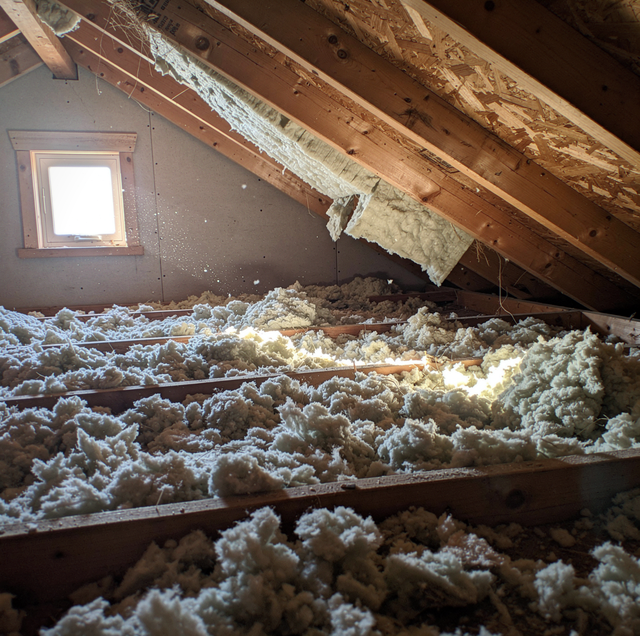
Check the attic floor with a tape measure or ruler, not a glance. A thin, compressed, or uneven layer of insulation, especially near the eaves, is the detail that lets an ice dam form even in a house that seems otherwise well built.
Why the Eave Is Always the Weak Point
Insulation depth is hardest to maintain right where the roof slope meets the exterior wall, because the rafter bays get shallow there and batts or blown-in fill get squeezed thin or pushed aside to keep the soffit vents clear. That means the coldest part of the roof sits over the thinnest part of the insulation, which is the opposite of what you'd want if you were trying to keep that section cold on purpose. A roof deck that is uniformly cold from ridge to eave does not build ice dams, because there is no warm zone to generate meltwater in the first place. It is the mismatch, warm upper deck feeding water down onto a cold lower deck, that creates the dam.
Air Leaks Do as Much Damage as Missing Insulation
Insulation slows heat moving through a surface, but it does very little to stop air from moving through gaps. A ceiling with plenty of insulation on top of it can still leak a steady stream of warm, moist household air if the air barrier underneath has holes: an unsealed attic hatch, a bath fan duct that dumps into the attic instead of venting outside, gaps around recessed lighting, or penetrations for plumbing vent stacks and electrical wiring. That escaping air carries both heat and moisture, and it warms the roof deck from below far more efficiently than heat slowly conducting through solid insulation ever would. A house can have a respectable insulation depth and still build ice dams every year because the real problem sits underneath the insulation, not on top of it.
Ventilation Is the Third Piece, Not a Substitute
A balanced attic ventilation system, with cool air pulled in low at the soffits, and warm air pushed out high at the ridge, helps keep the whole roof deck closer to outdoor temperature, which counteracts the warm-zone problem that starts the melt cycle. But ventilation cannot do the job alone. If a house is losing a lot of heat into the attic, no amount of airflow can fully offset it, and if soffit vents are blocked by insulation stuffed too far into the eave, the ventilation system cannot draw in the intake air it needs, regardless of how much exhaust capacity is at the ridge. Ventilation, insulation, and air sealing work as a system; treating any one of them as a fix for the others usually falls short.
The Damage Behind the Dam
Water that backs up under shingles does not stop at the roofline. It follows the path of least resistance, which is often down into the fascia board, behind the gutter, into the soffit, and from there into exterior wall cavities or straight through the ceiling drywall of the top-floor rooms. A stain that appears on a bedroom ceiling in February is often the first visible sign of an ice dam that has been forming for days. Left unaddressed across repeated winters, that intrusion point can rot sheathing and framing and soak insulation, which then loses much of its own R-value and makes the next winter's heat loss worse, not better.
Fixing the Cause Instead of Chasing the Ice
Because an ice dam is the result of heat loss and air leakage, the fix that actually holds up is one that closes the gap between the attic and the living space below, not one aimed at the ice itself.
Bring attic insulation up to a consistent, adequate depth, with particular attention to the eaves, where baffles keep soffit vents open while still allowing full insulation depth right out to the edge. A thin ring around the perimeter undermines an otherwise solid attic.
Seal the air leaks in the ceiling plane before adding new insulation on top of old, since covering a leak does not stop it; it just hides where the warm air is escaping. Common targets are the attic hatch, recessed lighting not rated for insulation contact, plumbing and wiring penetrations, and any bath or kitchen fan duct that terminates in the attic instead of outdoors.
Confirm intake and exhaust ventilation are balanced so the roof deck can shed the modest heat it receives rather than trapping it beneath a still layer of attic air.
None of this is a homeowner project best handled by climbing onto a snow- or ice-covered roof. If a dam has already formed, removing it safely is a job for a professional with the right equipment; the more useful thing a homeowner can check from solid ground is what is happening below the roof deck, in the attic itself.
Frequently Asked Questions
Less than most people assume. Ice dams need to cycle between melt and refreeze, which occurs across a wide range of winter conditions, from a hard deep freeze to milder weather that still dips below freezing at night. A well-insulated, well-sealed, well-ventilated attic can go through an entire cold season with a roof deck close to outdoor temperature and never generate the warm zone that starts the melt. The insulation and air-sealing conditions of the attic are the variables a homeowner actually controls; the weather isn't.
Icicles and ice dams come from the same melt-refreeze process but aren't identical. Icicles form where water drips off an edge and freezes in open air, which can happen even with a well-performing roof if snow melts a little at the very edge on a sunny, above-freezing afternoon. A true ice dam is a thicker ridge that has accumulated enough mass to form a pool of standing water behind it. Icicles alone are a lower-concern sign; a visibly thick ice ridge with water pooling above it is the one worth having assessed.
Metal roofing sheds snow differently because its smooth, low-friction surface lets accumulated snow slide off in sheets rather than melting and refreezing in place layer by layer, which can reduce dam formation in some designs. But a metal roof over a heat-leaking, poorly insulated attic can still develop dams, especially where snow guards or roof valleys hold snow in place long enough for the melt-refreeze cycle to run. Roofing material changes the odds; it does not remove the underlying cause of attic heat.
Not necessarily, though a north-facing slope that gets little direct sun tends to hold snow and ice longer once a dam has formed, since sunlight isn't helping melt it from above. The dam itself is driven by attic heat loss from below, which affects any slope roughly equally if the insulation and air sealing above it are uniform. A dam that's noticeably worse on one side of a house is often a clue that the insulation or air sealing is thinner or leakier on that specific section of attic, not that the sun exposure alone explains it.
Heat cables (also called heat tape) run along the eave and gutter and can create a channel for meltwater to drain through an existing dam, which helps manage water intrusion in the moment. Gutter guards mainly keep debris out and do little to stop the melt-refreeze cycle itself. Both are downstream patches that address symptoms at the roofline; neither changes the attic heat loss that started the ice building in the first place, so a house that needs heat cables every winter usually still has an insulation or air-sealing gap worth finding.
It varies with snow load and temperature swings, but water intrusion can begin within days of a dam reaching a height that pools standing water against the shingles, since the freeze-thaw cycle repeats whenever daytime temperatures climb above freezing. A dam that survives multiple thaw cycles without draining is actively holding a growing pool of water against the roofing the entire time. That's why a ceiling stain that appears mid-winter should prompt an attic check rather than a wait-and-see approach.
Book a free attic assessment — find the heat loss and air leaks that build ice dams before the next freeze-thaw cycle. Airflow Pro Insulation serves St. Joseph, Savannah, and Country Club. Call (816) 344-6516.
