
How Soundproofing Insulation Quiets a Home (and Its Limits)
Quick Answer: Insulation quiets a home mainly by absorbing airborne noise inside wall, floor, and ceiling cavities, which softens sound and stops it from bouncing straight through hollow framing. It works best against voices, TV, and music, and helps far less with footsteps and other impact noise carried through the structure. For big gains, insulation is paired with added mass and decoupling, not used on its own.
You can hear the neighbor's television through the shared wall, the kids upstairs sound like they are dropping bowling balls, and a normal conversation two rooms away carries as if the doors were open. Sound moves through a house in ways most people never think about until it starts costing them sleep or privacy. Insulation is one of the most useful tools for calming that noise, but only once you understand what it actually does to sound and, just as important, what it cannot do on its own.
How Sound Actually Travels Through a House
Noise reaches your ears in two different ways, and telling them apart is the whole basis for fixing them.
Airborne noise is sound moving through the air: voices, music, a barking dog, the TV. Those pressure waves slip through any gap they can find and set thin surfaces vibrating. A hollow wall is the easy path, because the wave hits one side of the drywall, makes it flex like a drum skin, and that vibration re-radiates as sound into the cavity and out the far side. Gaps around outlets, along the base of a wall, or under a door let the sound skip the wall entirely and travel straight through the air.
Impact noise, also called structure-borne noise, is sound created by something striking the building itself: footsteps on the floor above, a dropped shoe, a slammed cabinet, a washing machine on spin cycle. That energy travels as vibration through the joists, studs, and subfloor, often for a surprising distance, before it radiates back out as audible sound in another room. Because it rides the solid structure rather than the air, impact noise is the harder of the two to stop.
Most annoying household noise is a mix of both, which is why a single fix rarely silences everything. Knowing which type dominates in your situation points you at the right solution.
How Insulation Absorbs Sound Inside a Cavity
An empty wall or floor cavity is essentially a drum. The two drywall faces are connected by air, and that trapped air lets a sound wave pass from one side to the other with little resistance. Worse, the hollow space has resonances, certain pitches that the cavity naturally reinforces, so some frequencies actually come through louder than they went in.
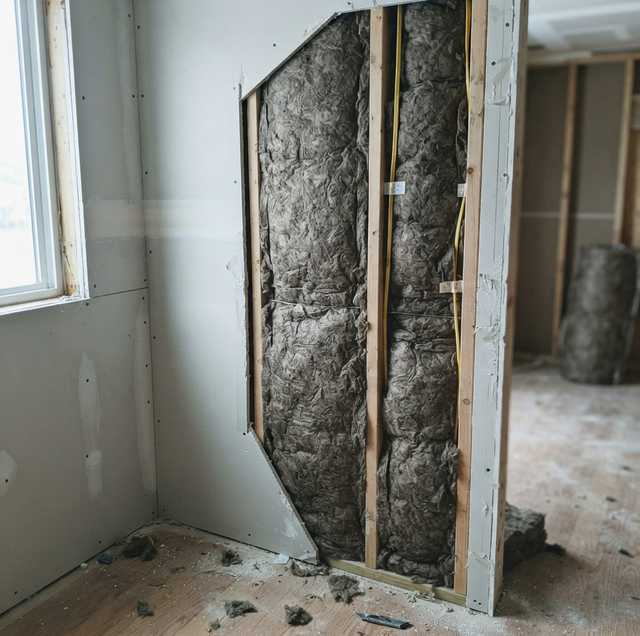
Filling that cavity changes the physics. Fibrous insulation, whether batts, blown-in loose fill, or mineral wool, is full of tiny air pockets and countless fiber surfaces. As a sound wave moves through it, the air is forced to squeeze through those narrow passages, and friction converts a portion of the sound energy into a trace of heat. The wave comes out the other side measurably weaker. The insulation also damps the cavity's natural resonance, flattening those reinforced pitches so the wall stops acting like a speaker box.
The effect is strongest on airborne noise across the mid and high frequencies, which is exactly where speech and television sit. That is why a filled wall makes a conversation next door drop from clearly intelligible to a muffled murmur. Deep bass, being long, slow waves carrying a lot of energy, is far harder for insulation alone to tame.
Why air-sealing the gaps matters for sound too: Absorption inside the cavity does nothing for sound that never enters the cavity in the first place. Air and sound follow the same leaks. The gap where a wall meets the floor, the annular space behind an electrical box, a poorly fitted door, and unsealed penetrations for pipes and wires all give airborne noise a bypass around your insulation. Sealing those openings, the same detailing that stops drafts, closes the shortcut and lets the insulation do its job. A wall packed with mineral wool but riddled with open gaps will still leak voices through those gaps.
When you insulate for quiet, seal the leaks first. Voices slip through the gap where a wall meets the floor, the space behind an electrical box, and unsealed pipe or wire penetrations, skipping right past the insulation. Closing those openings lets the material actually do its job.
Understanding STC Without the Jargon
When products advertise sound performance, they cite an STC rating, short for Sound Transmission Class. In plain terms, it is a single number summarizing how much airborne noise an assembly blocks across a range of speech-relevant frequencies. Higher is quieter. A bare interior wall might land in the low 30s, where you can hear normal speech through it fairly clearly. Push into the upper 40s and 50s and loud speech fades to a faint mumble.
Two things are worth holding onto. First, STC weighs the mid and high frequencies where speech lives, so it does not describe how well an assembly stops thumping bass or heavy footsteps. Second, it rates a specific tested assembly as a whole, not the insulation by itself. Insulation is one contributor to that number, alongside the drywall, the framing, and how well everything is sealed.
Where Soundproofing Insulation Helps Most
Cavity insulation earns its keep wherever airborne noise crosses an interior partition or an uninsulated floor. A few situations deliver the clearest payoff.
Shared and party walls: A wall between a bedroom and a living room, a home office and a playroom, or the demising wall of a townhouse is the classic case. These interior walls are usually built hollow, so filling the cavity is often the single most cost-effective step toward privacy from voices and media.
Media rooms and home offices: A theater room benefits in two directions. Insulation keeps the soundtrack from bleeding into the rest of the house, and it trims some of the echo inside the room by absorbing reflections at the wall surface. A home office gains privacy for calls in both directions.
Bedrooms and floors between levels: Insulating the floor and ceiling cavity between two levels cuts the airborne share of upstairs noise, muffled voices, a TV, music, so a bedroom below a busy family room becomes noticeably calmer. It softens footstep noise somewhat as well, though impact sound needs more than insulation to truly control.
Mineral Wool vs. Fiberglass for Sound
Both materials quiet a cavity by the same absorption mechanism, and both help. The practical differences are density and handling.
Mineral wool, sometimes called rock wool or stone wool, is denser and stiffer than standard fiberglass. That higher density makes it a slightly more effective sound absorber cavity-for-cavity, and the batts are firm enough to friction-fit snugly between studs without sagging or leaving gaps, which matters because gaps leak sound. Its density is why acoustic-minded installers often reach for it first.
Fiberglass is lighter, less expensive, and still a strong performer, especially in higher-density acoustic batts made for the purpose. Standard thermal fiberglass helps meaningfully too, so the choice often comes down to how much quiet you are after and the budget. For most interior walls, either material takes you from a hollow, resonant partition to a noticeably calmer one.
What Insulation Alone Will Not Do
Here is the honest limit, and it is the part homeowners most often wish were different. Insulation absorbs sound energy, but it does not add much mass, and it does not break the physical connection through the framing. Those two things, mass and decoupling, are what stop the toughest noise.
Blocking low-frequency and impact noise takes mass: heavy, dense surfaces that resist being set into vibration. A second layer of drywall, ideally with a damping compound between the layers, adds that mass and can lift an assembly's rating well beyond what insulation alone reaches.
Impact noise also demands decoupling, physically separating the two sides of the assembly so vibration cannot travel straight across the studs or joists. Resilient channel, sound isolation clips, or staggered and double-stud framing create that break. Without decoupling, a heavy footstep on the floor above still telegraphs down through solid joists no matter how much insulation sits in the cavity.
Set expectations accordingly. Filling a wall reliably takes airborne noise from clearly audible to muffled, a real and welcome improvement. Turning a room into a recording booth, or fully silencing the footsteps overhead, calls for the layered approach: absorption plus mass plus decoupling working together. Insulation is the foundation of that stack, not the entire solution.
Frequently Asked Questions
Not usually, despite the assumption. Closed-cell spray foam is rigid and dense, so it actually transmits vibration fairly well and is a mediocre acoustic absorber. Open-cell foam performs better for sound than closed-cell, but a fibrous product such as mineral wool or an acoustic fiberglass batt generally outperforms both for airborne noise in an interior wall. Foam is chosen for air sealing and thermal performance, not primarily for quiet.
Fill it fully and snugly, but do not overstuff it. Compressing insulation packs the fibers tight, shrinks the air pockets that create the friction sound needs to pass through, and can actually reduce absorption. A batt that friction-fits corner to corner with no gaps and no crushing is ideal. Leaving portions of the cavity empty gives sound an open resonant channel around your material.
It helps modestly with the airborne portion of upstairs noise but does little for the actual footstep thud, because that impact energy travels through the joists themselves, not the cavity air. Controlling footsteps usually starts at the floor above: a resilient underlayment or a floating floor assembly to cushion the impact, sometimes combined with decoupling the ceiling below on isolation clips.
Sound absorption improves with cavity depth, so a standard 2x4 wall roughly 3.5 inches deep gives less absorption than a 2x6 wall around 5.5 inches, especially for lower frequencies. You cannot exceed the depth the framing allows without furring it out, so the framed cavity depth sets your ceiling. Even a filled 3.5-inch wall delivers a clear improvement over an empty one; a deeper cavity simply widens the frequency range it tames.
Yes, and it is a genuine dual benefit. Mineral wool is spun from rock and slag and is noncombustible, typically withstanding temperatures well over 1,000 degrees Fahrenheit without melting, which is why it is common in fire-rated wall assemblies. So the same dense batt chosen for acoustics also contributes fire resistance to the partition, a bonus fiberglass provides to a lesser degree.
Yes, through dense-pack blown-in insulation. An installer bores small holes in the drywall, blows loose fill under pressure until the cavity is packed firmly, then patches the holes. Dense-packing reaches a high enough fill density to absorb sound well and avoids gutting the room. It is a common retrofit for quieting an existing shared wall when opening the wall is not practical.
Ask about a home noise assessment and a cavity insulation plan built for your walls — quieter rooms without a full remodel. Airflow Pro Insulation serves St. Joseph, Savannah, and Country Club. Call (816) 344-6516.
