
Open-Cell vs Closed-Cell Spray Foam: Which One Fits?
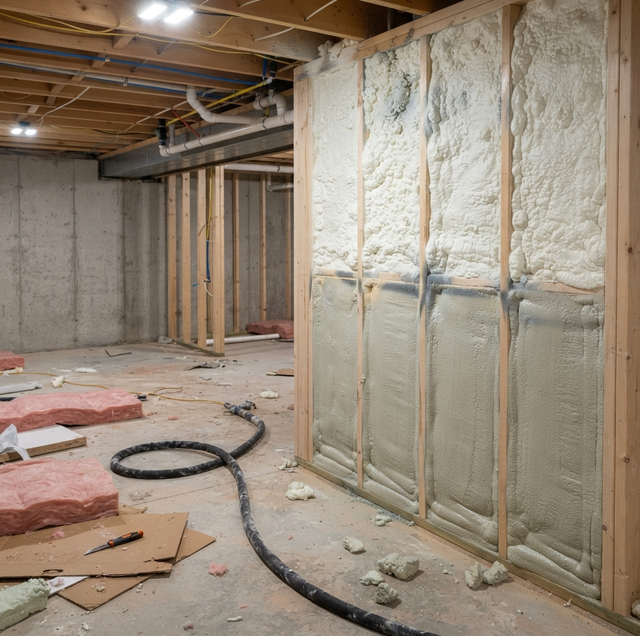
Quick Answer: Open-cell spray foam is soft, lightweight, and air-sealing, with a lower R-value per inch and no vapor barrier, which suits interior walls and sound control. Closed-cell foam is dense and rigid, carries a higher R-value per inch, resists water, and acts as a vapor barrier, which suits tight cavities, crawl spaces, and anywhere moisture is a concern. Both seal air far better than batts.
Spray foam gets sold as one product, but it arrives on the truck as two very different materials that happen to share a name. Ask for spray foam and an installer will follow up with a question of their own: open-cell or closed-cell? The answer changes the R-value you get per inch, whether the foam blocks moisture, how much rigidity it adds, and what the job costs. Understanding the split before you commit keeps you from paying for the wrong foam in the wrong space.
The Cell Structure Behind the Two Types
Both foams are spray polyurethane, mixed on site from two liquid chemical components that react, expand, and harden in seconds. The difference lives at a microscopic level, in whether the tiny cells that form during that reaction stay open or seal shut.
In open-cell foam, the little bubbles are left broken and interconnected. Air fills those pockets, which is why the cured foam is soft, spongy, and light enough to press with a finger. Because the cells are open, air and some water vapor can move slowly through the material.
In closed-cell foam, each bubble is sealed and packed tightly against its neighbors. Many are filled with a blowing agent rather than plain air, and the walls between them stay intact. That sealed structure is what makes the cured foam dense, hard, and far more resistant to the passage of air, vapor, and liquid water.
Everything that separates the two products traces back to that one structural fork. Insulating value, moisture behavior, rigidity, and cost all follow from whether the cells are open or closed. Keep that picture in mind, and the comparison below stops feeling like a list of random specs.
Open-Cell Spray Foam
Open-cell foam is the lighter, airier of the two. It carries an R-value of roughly R-3.5 per inch, which is respectable but lower than its dense cousin. Where it stands out is expansion: it swells dramatically after application, often many times its sprayed volume, so it fills irregular cavities, curls around wiring, and reaches into gaps that rigid materials miss.
That heavy expansion makes it efficient for large open cavities. A single pass can flood a stud bay or the underside of a roof deck and fill it. Because it uses less raw chemical to cover the same space, open-cell is generally the more budget-friendly option.
The soft, air-filled structure also dampens sound. Open-cell foam absorbs airborne noise well, which is why it shows up in interior partition walls, around media rooms, and between floors where quiet matters more than moisture control.
Where open-cell falls short
Open-cell is not a vapor barrier. Water vapor can pass through it, and the material can absorb and hold liquid water if it gets wet. That makes it a poor fit for spaces where moisture is a real threat, such as below-grade walls or damp crawl spaces, unless a separate vapor strategy is designed in. It also delivers less R-value in a given thickness, so shallow cavities that need high performance are not its strength.
Closed-Cell Spray Foam
Closed-cell foam is the dense, rigid, heavyweight option. It delivers roughly R-6 to R-7 per inch, nearly double open-cell, so it packs more insulating power into every inch of thickness. In a shallow cavity where you cannot afford to lose depth, that difference is decisive.
The sealed structure resists water. Closed-cell foam does not readily absorb liquid, and at adequate thickness it functions as a vapor barrier, slowing the drive of moisture through the assembly. That combination makes it the standard choice for crawl spaces, below-grade walls, rim joists, and exterior applications where dampness is part of the environment.
There is a bonus most homeowners never expect: rigidity. Once cured, closed-cell foam is hard enough to add measurable racking strength to a wall, stiffening the structure it bonds to. It also excels in tight or hard-to-reach spaces, since it hits high R-value without needing much depth.
Where closed-cell asks more of you
All of that density comes at a higher price. Closed-cell uses more chemical per square foot and costs more to install than open-cell for the same coverage. It expands far less, so it will not balloon out to fill a deep, irregular cavity the way open-cell does; it is applied in controlled layers instead. For a big open attic where moisture is not the main worry, that premium may buy performance you do not actually need.
The Air Seal Both Foams Share
Before the two foams part ways, they agree on their single biggest advantage over traditional insulation: both seal air. Fiberglass batts and blown cellulose slow heat, but air still leaks freely through the gaps, seams, and penetrations around them. Spray foam, open or closed, expands into those gaps and hardens into a continuous barrier that stops air movement.
That air seal is often the real reason a foamed home feels different. Drafts fade, dust and outdoor air have fewer ways in, and heating and cooling equipment stops fighting a constant leak. A batt with a high R-value in a leaky wall underperforms its rating, because air carrying heat simply routes around it. Foam closes that path.
The distinction is about degree. Both types stop air; only closed-cell also stops vapor and liquid water at the thicknesses commonly installed. If air sealing is the whole goal and moisture is handled elsewhere, open-cell delivers it at lower cost. If you need the air seal plus moisture defense in one product, closed-cell does both.
Weighing the Tradeoffs
Set the two side by side, and the decision comes down to a handful of levers. R-value per inch favors closed-cell, roughly R-6 to R-7 against open-cell's R-3.5, so depth-limited cavities lean closed. Cost favors open-cell, which covers more area for less chemical, so large open volumes lean open.
Moisture is often the deciding factor. Anywhere liquid water or persistent humidity is in play, closed-cell's water resistance and vapor-barrier behavior earn their keep. In dry interior spaces where sound or simple air sealing is the aim, open-cell's softness and lower price win.
A simple way to frame the choice
Think of the two foams the way you would a winter coat versus a windbreaker. The heavy coat, closed-cell, is dense, sheds moisture, and holds the most warmth in the least bulk, but it costs more and is overkill for a mild day. The windbreaker, open-cell, is light and cuts the wind well for less, yet it soaks through in a downpour. Neither is better in the abstract; the right pick depends entirely on the conditions it has to face.
Space geometry matters too. Tight, shallow, or hard-to-reach areas reward closed-cell's high R-value per inch. Deep, open, irregular cavities reward open-cell's dramatic expansion and lower cost. Match the foam to the job rather than picking a favorite and forcing it everywhere.
Why Both Foams Need a Professional Installer
Spray foam is a chemical reaction, not a product you unroll. The two liquid components must be metered at the correct ratio and sprayed at the right temperature; a bad mix or off ratio can leave foam that never fully cures, stays tacky, or off-gasses odor long after the crew leaves. Getting the chemistry right is a trained skill, not a rental-store afternoon.
Thickness discipline matters just as much. Closed-cell in particular must go on in controlled layers, or lifts, because a single pass applied too thick can trap heat as it cures, scorch, or fail to bond correctly. An installer builds it up in measured passes and lets each cure before the next.
Uncured spray foam is a chemical reaction with real hazards. The raw components contain isocyanates that demand respirators, protective gear, and active ventilation during spraying and curing, and a space needs a re-occupancy waiting period before people move back in. For anything beyond a tiny patch, that puts the work outside safe do-it-yourself territory.
Barriers, clearances, and code
Cured spray foam is combustible, so building codes generally require a thermal or ignition barrier over it wherever it stays exposed, such as in a living space or an accessible attic. The exact requirement varies by location and assembly, so verify it locally rather than assuming. Foam also needs proper clearance from heat sources like chimneys, flues, and certain recessed fixtures. A professional plans those barriers and clearances into the job from the start, which is one more reason the install is not a weekend project.
Choosing Based on the Space and the Moisture
Start with two questions: how much depth do you have, and how much moisture is in the space? Shallow cavity plus moisture points hard toward closed-cell. A deep, dry interior cavity where sound or air sealing is the goal points toward open-cell.
Crawl spaces, rim joists, below-grade walls, and exterior applications are classic closed-cell territory, because they combine dampness with the need for a vapor barrier. Interior partition walls, large attic decks in dry conditions, and sound-sensitive rooms are natural open-cell candidates, where its expansion, quiet, and lower cost do the most good.
Many homes end up using both, matched to each area rather than standardized across the house. The goal is not to declare a winner but to put the right foam where its strengths line up with the space. An assessment of your specific assemblies, depths, and moisture exposure is what turns that principle into a plan.
Frequently Asked Questions
Quality closed-cell foam holds most of its R-value long-term, but its rated number can drift slightly in the early period as the blowing agent inside the sealed cells settles, which is why published ratings reflect an aged value rather than the day-one peak. Open-cell, which is filled with plain air rather than a blowing agent, does not have that early drift.
Yes, and hybrid or flash-and-batt assemblies do exactly that. A thin flash coat of closed-cell against the sheathing establishes the vapor and air control, then a cheaper fill of open-cell or even batt insulation builds the rest of the R-value. It captures closed-cell's moisture defense without paying closed-cell prices for the full cavity depth.
Most manufacturers specify a re-occupancy window, commonly around 24 hours after spraying, before the space is safe to reoccupy without protective gear. However, the exact time depends on the product and ventilation. The area should be actively ventilated during that window to clear off-gassing before normal use resumes.
Neither foam is a food source, so pests do not eat it for nutrition, but rodents can and do chew tunnels through cured foam to move through a wall. Closed-cell's harder density makes it modestly more resistant to that gnawing than soft open-cell, though foam alone is not a pest barrier and should not be treated as one.
Closed-cell only performs as a vapor barrier once it reaches a minimum thickness, often cited around two inches, because a thinner skim does not fully close the vapor path. Below that depth, it still seals air but lets more moisture through, which is why installers spec a target thickness rather than just spraying a thin coat.
Cured foam bonds aggressively to the surfaces it touches and does not peel off cleanly, so removal means physically scraping, cutting, or grinding it away rather than pulling it loose. That permanence is worth weighing before you foam a surface you might later need to access, since undoing it is labor-intensive compared with batts you can simply lift out.
Not sure which foam fits your space — get an in-home assessment of your cavities and moisture before you commit. Airflow Pro Insulation serves St. Joseph, Savannah, and Kansas City. Call (816) 344-6516.
