
A basement that feels cold in one season and damp in another is not two separate problems. It is one mechanism showing up two different ways. The same uninsulated concrete, the same gaps at the rim joist, and the same cool surfaces that make a basement feel chilly are also why it feels sticky, smells musty, and forms condensation on pipes and walls. Once you understand how heat and moisture actually move through a below-grade space, the cold and the humidity stop looking like unrelated complaints and start looking like the predictable result of a few specific, fixable gaps in the building itself.
This is the piece that gets missed. A basement is not simply "the coldest room in the house." It is a room where the walls themselves act almost like the outdoors, radiating cold into the living space regardless of the season, because there is little or no insulation between the concrete and the air to slow that heat exchange.
The Basement Lives at a Different Temperature Than the Rest of the House
Most of a basement's walls sit against soil, and soil maintains a fairly steady temperature year-round, often cooler than the air inside a heated or cooled home. That means bare concrete or block foundation walls stay close to ground temperature no matter what the thermostat upstairs is set to. In winter, those cool walls draw warmth from the basement air. In warmer, muggier weather, those same walls stay noticeably cooler than the humid air moving through the space, which creates the exact conditions needed for condensation.
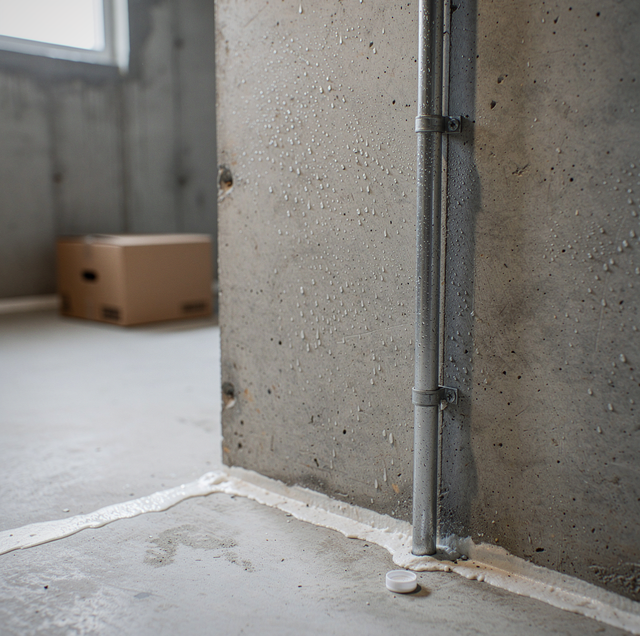
Warm air holds far more moisture than cool air. When warm, humid air drifts into a basement and touches a cold foundation wall, a cool concrete floor, or an uninsulated pipe, that air cools rapidly at the surface. Cooling air loses its capacity to hold moisture, and once it drops below its dew point, the excess moisture condenses directly onto that cold surface. That is the source of the beads of water on a basement wall, the damp ring on a concrete floor, or the sweating on cold-water pipes that homeowners often mistake for a leak.
None of this requires a plumbing problem or a flood. It only requires warm, moist air meeting a cold surface, which is exactly what an uninsulated basement provides in abundance. The musty smell that so often accompanies a cold basement comes from this same condensation cycle: persistent surface moisture supports mold and mildew growth on framing, drywall, and stored belongings, and that growth is what produces the smell.
Why the Air Down There Feels So Damp
Bare foundation walls have no thermal break between the living space and the cold soil outside. Every square foot of exposed concrete or block becomes a surface that closely tracks ground temperature, and every square foot of that cold surface is a potential condensation point once humid air reaches it. Insulating those walls does two things at once. It raises the wall's interior surface temperature above the dew point of the room's air, preventing condensation from forming there, and it slows the continuous transfer of cold from the soil into the living space, which is what makes the room feel warmer to begin with.
Homes with finished basements often assume that drywall and studs already provide this protection. In many cases, they do not. Framing built directly against a bare wall, with no insulation and no vapor control behind it, still allows the wall to condense just out of sight, where moisture can sit against the wood framing and drywall paper, causing damage long before anyone notices a smell or a stain.
Uninsulated Foundation Walls Make the Problem Worse
The rim joist is the band of framing that sits on top of the foundation wall, right where the first floor meets the basement below. It is one of the most commonly overlooked gaps in a home's building envelope. This area often gets little or no insulation, and where it does have insulation, it frequently lacks air sealing behind it, leaving small gaps around plumbing lines, wiring, and the joists themselves.
Because this band sits right at the transition between outside and inside, it behaves like a ring of holes around the top of the foundation. Outside air, hot and humid in summer, cold and dry in winter, moves through those gaps more or less directly into the basement. That incoming air brings its outdoor temperature and its outdoor moisture level with it, undoing whatever conditioning the rest of the basement is getting. A basement can have decent wall insulation and still stay cold and damp if the rim joist band above it is left essentially open to the outdoors.
The Rim Joist Gap Problem
A cold, humid basement usually draws moisture from more than one source at once.
- Vapor moving through the concrete itself: Concrete is porous, and moisture from the soil around a foundation can migrate slowly through the material and evaporate into the basement air, even without any visible cracks or standing water.
- Humid outside air infiltrating through gaps: Rim joist gaps, unsealed penetrations, and older basement windows all let outside air, and the moisture it carries, into the space.
- Warm, moist air drifting down from upper floors: Showers, laundry, and cooking generate humidity that can settle into the coolest part of a house, which is usually the basement.
- Poor grading or drainage around the foundation: Water pooling against the outside of a foundation wall increases the moisture pressure pushing through the concrete and into the basement.
Each of these sources adds to the same pool of moisture, and that moisture condenses on the coldest surfaces in the room.
Where the Moisture Actually Comes From
Cold surfaces attract condensation, and condensation keeps surfaces cold, since evaporating moisture pulls additional heat away from whatever it is sitting on. A damp concrete wall or floor remains a few degrees cooler than a dry one due to the evaporative effect, which in turn encourages more condensation to form. Once mold or mildew takes hold in that moist environment, it thrives in the same cool, damp range that started the cycle in the first place. Left alone, a cold, humid basement rarely improves on its own; the conditions that created it reinforce themselves.
Cold and Humid Feed Each Other
A few clues point directly to this cold-and-damp cycle rather than a one-time leak or a plumbing issue.
- A musty smell that lingers even when nothing appears visibly wet.
- Beads of condensation on foundation walls, windows, or cold-water pipes, especially in warmer, humid weather.
- White, chalky mineral deposits on concrete surfaces, a sign of moisture migrating through and evaporating at the surface.
- Peeling paint, rusted fasteners, or soft drywall near the base of foundation walls.
- Floors above the basement that feel noticeably cold underfoot, especially near exterior walls.
Any one of these on its own is worth a look. Several that appear together almost always point to uninsulated walls, an unsealed rim joist, or both.
Signs This Mechanism Is Already at Work
Fixing a cold, humid basement means addressing the mechanism rather than just the symptoms. Insulating the foundation walls with a vapor-appropriate material raises their surface temperature above the dew point of the room's air, which removes the cold surface that condensation depends on. Sealing and insulating the rim joist closes off the band of gaps that lets outdoor temperature and moisture pour directly into the space. Managing moisture at its source, through proper grading, a ground-level vapor barrier where the basement has an exposed dirt or unsealed floor area, and controlling humidity generated inside the home, reduces the total amount of moisture available to condense in the first place. Ventilation or mechanical dehumidification can help manage humidity day-to-day, but on its own it works against a room that is still losing conditioned air and has cold, uninsulated surfaces that invite condensation. Pairing air sealing and insulation with moisture control is what actually stops the cycle rather than just masking it.
Breaking the Cycle
Frequently Asked Questions
Basement walls sit against soil that stays cooler than a heated home for most of the year, and without insulation, those walls constantly draw warmth out of the room. The rim joist band at the top of the foundation often contributes to this by allowing outside air to move directly into the space, so even a basement with a working heating system can feel noticeably colder than the floors above it.
No. Condensation forms whenever warm, moist air comes into contact with a cold surface, which occurs constantly in an uninsulated basement, regardless of whether there is any active water intrusion. Beads of moisture on walls, floors, or pipes are frequently condensation rather than a leak, though ongoing dampness is still worth having assessed to rule out water entry from outside.
Persistent surface condensation, even in small amounts, is enough to support mold and mildew growth on framing, drywall, insulation, and stored items. That growth produces a musty odor long before moisture becomes visible to the eye, which is why a smell can appear in a basement that otherwise looks dry.
Often, yes, since many finished basements were built with framing placed directly against bare concrete, with no insulation or vapor control behind the drywall. In that setup, the wall can still condense out of sight, and moisture can sit against the framing and drywall paper without being noticed until damage or odor appears.
The rim joist is the band of framing where the first floor meets the top of the foundation wall. It is frequently under-insulated and poorly sealed, which lets outdoor air and moisture move directly into the basement year-round. Sealing and insulating this band is one of the most effective single steps in stopping a cold, damp basement.
A dehumidifier can reduce moisture in the air day-to-day, but it does not address cold, uninsulated surfaces or gaps at the rim joist that keep bringing in outside air and moisture. Pairing insulation and air sealing with humidity control addresses the root causes rather than continuously working against them.
Every part of this mechanism- the cold foundation walls, the gaps at the rim joist, and the condensation that forms where warm air meets cool surfaces- points back to the building envelope itself rather than to anything random about the weather. Once those gaps and surfaces are addressed, a basement stops fighting its own temperature and moisture problems and starts holding steady like the rest of the home.
Get a basement insulation and air-sealing assessment — a trained technician will identify where cold surfaces and gaps are driving the moisture and temperature swings in your basement. Airflow Pro Insulation serves St. Joseph, Savannah, and Country Club. Call (816) 344-6516.
